

Cloudy skies greeted early morning voters in Oakland, where the forecast on Election Day called for rain throughout the day.
Oakland voters will be casting ballots for mayor, city council and school board, as well as considering a charter change that would bring a new form of government.
Incumbent Mayor Barbara Lee is running for reelection against three challengers: Brenda Grisham, Mindy Pechenuk and Julius Robinson.
Council President Kevin Jenkins is trying to hold onto his District 6 seat, against opponent Nancy Sidebotham. District 2 City Council incumbent Charlene Wang is hoping to fend off a challenge by Nate Adams.
Oakland Unified School District board President Jennifer Brouhard is seeking another four years, with Arielle Fleisher challenging in District 2. Mike Hutchinson, a six-year incumbent, is running against Kathryn Camp in District 4. And incumbent Valerie Bachelor has two District 6 challengers — LeAna Powell and Alexandra Williams.
Oakland City Council is asking voters to change the city charter to give the mayor veto power and the City Council power to override a mayor’s veto. The change would bring a strong mayor form of government to Oakland, with the mayor appointing and having direct authority over department heads.
Voters also will decide if the city should amend its property transfer tax by removing the exception on foreclosed properties, which would generate $4 million to $13 million annually.
Oakland North will be at the polls, talking to voters about issues important to Oakland residents. This report will be updated throughout Election Day.
8 a.m.
Outside the El Cerrito del Norte BART station, three people canvassed for a regional transit measure, holding signs and handing out flyers. A man riding his bike to catch the train shouted, “Thank you for your work.”
The proposed regional transit measure would increase sales taxes to raise nearly $1 billion for transit agencies, including BART, AC Transit, Muni and Caltrain, which face budget shortfalls and potential service cuts.
Fruhar Safa, who moved to the East Bay five months ago, said it was time to pass Proposition 40, California’s proposed billionaire tax, after “seeing such visible signs of what happens when we allow wealth disparity to grow.”
Chao Tsung Yang, who was born in Taiwan, has lived in Oakland for eight years. Riding BART is part of his daily routine.
Yang supports the regional transit measure but is uncertain whether it would lower fares. He contrasted transit in the Bay Area with Taiwan, where he said public transportation is more affordable and accessible.
Reporter: Mary Mijares
9:48 a.m.
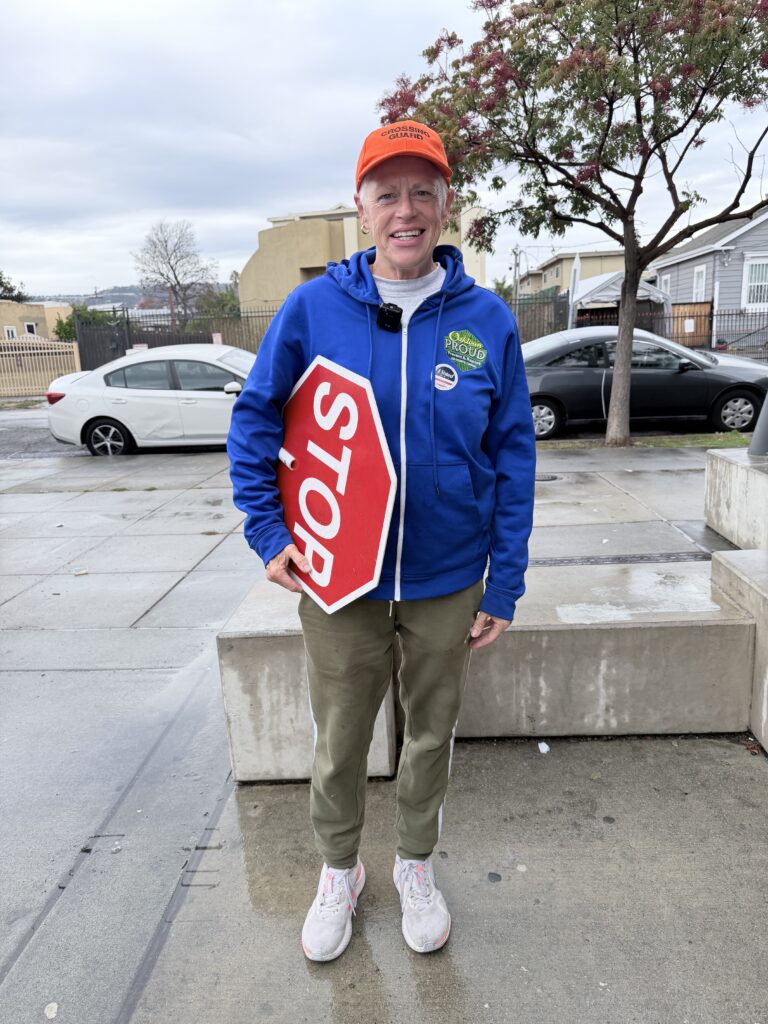
Lisa Ruhland, 64, works as an Oakland crossing guard and voted at the 81st Ave Branch Library. She has been living in Laurel for over three decades and said people rely on public transportation to get to school, to work, to the doctor’s office. For her, it’s essential that the Regional Transit Measure pass.
“I want us to pay the sales tax to keep it afloat,” Ruhland said. “I understand that there’s so much waste, and I understand all those agencies are so inefficient, but that doesn’t mean we can afford for them to cut lines.”
The measure would add a half-cent sales tax in Alameda and other counties to raise additional funding for transit systems, which have warned they may have to scale back on services if they aren’t able to get additional funding.
“Everyone needs to be able to get where they want,” she said.
Reporters: Duha Hmidan, Rachel Ababio
10:30 a.m.
District 2 incumbent Charlene Wang plans to spend part of Election Day outside the polling place at the Jack London Aquatic Center, according to her chief of staff, Michael Wimsatt.
Wang will join other incumbents seeking re-election, including Mayor Barbara Lee, District 6 Council President Kevin Jenkins and District 4 Councilmember Janani Ramachandran, at an election night party at Fluid510 at 7 p.m.
Around the corner from the East Bay Democratic Socialists of America headquarters, Oakland residents at a local coffee shop shared their thoughts about the election.
District 2 resident Dennis Orason said that while Wang has made efforts to improve the quality of life in her district and across Oakland, he plans to vote for her challenger, Nate Adams.
“I feel deeply that endorsing Flock and contributing to a more surveilled state is not what I want in Oakland and that’s why I’m voting for Nate Adams,” Orason said.
Standing out in the sprinkling rain in a crowded Trader Joe’s parking lot on Lakeshore Drive, a moderately wet Joyce Ching was handing out flyers from a thick stack of campaign materials for incumbent Charlene Wang.
“She’s got a lot of experience,” Ching said. “She knows what she’s talking about when it comes to public policy, what comes out of her speeches is mainly just solutions, so she’s very much solutions based.”
Reporter: Eric Urbach
10:22 a.m.
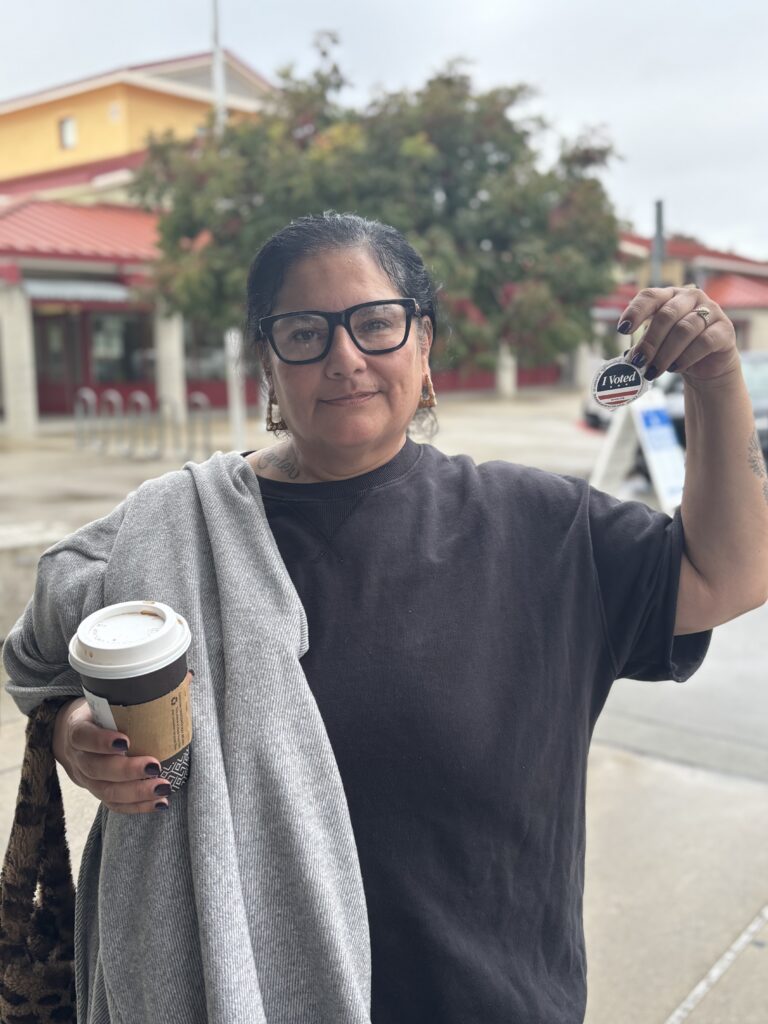
Jessica Jefferson, 53, arrived at the 81st Avenue Branch Library with a cheetah-print purse in one hand and coffee in the other. A lifelong East Oakland resident, Jefferson wants elected officials to be accountable to their constituents and address issues affecting their daily lives.
One of her biggest concerns is the impact of U.S. Immigration and Customs Enforcement on Oakland residents. She said the election would be a “good start” toward challenging what she described as the agency’s unlawful actions.
“It’s extremely aggressive, combative, and it’s hurting our community,” Jefferson said. “If you’re a citizen, if you’re a refugee, I don’t care. You deserve dignity and humanity.”
Jefferson, a teacher, said the school board elections are equally important. She believes it is time to stand up for students, parents and teachers.
“It’s very hard as a teacher to be able to make a difference and an impact in their community, and be there for kids at school when they don’t have resources,” she said.
Proposition 40, a proposed tax on billionaires, is also among Jefferson’s priorities. She pointed to the region’s income inequality, contrasting its wealthy residents with the many people experiencing homelessness. She believes the measure could help reduce those disparities and improve local communities.
Reporters: Duha Hmidan, Rachel Ababio
12:15 p.m.
Some Oakland voters expressed enthusiasm Tuesday morning for Proposition 40, which would impose a one-time 5% tax on the wealth of California billionaires. If approved, it would be the first tax of its kind in the country.
Jessica Jefferson, 53, a lifelong East Oakland resident who voted at the 81st Avenue Branch Library, said she believes the proposition could help reduce income inequality.
“We have too much of a differentiated line,” Jefferson said. “That is, you’re either broke or you’re super wealthy. There’s not much in between.”
Jefferson pointed to the stark contrast between the region’s millionaires and billionaires and its many residents experiencing homelessness.
She also said she hopes the measure could help fund struggling city services, including road repairs.
“If it does pass, then I do feel like it could help out our communities a lot,” she said.
Fruhar Safa, who moved to the East Bay five months ago, also supports the proposition. She spoke from inside the 19th Street Oakland BART station.
“About time,” she said.
Safa said growing wealth inequality has consequences for society and that the measure could generate revenue for public services. But she said the proposal falls short because it imposes only a one-time tax.
Oakland resident Joey K. said she supports the proposition because she believes it would help improve living standards. She pointed to the 1980s, when she said higher tax rates were associated with a higher standard of living.
Reporters: Mary Mijares, Duha Hmidan, Rachel Ababio